
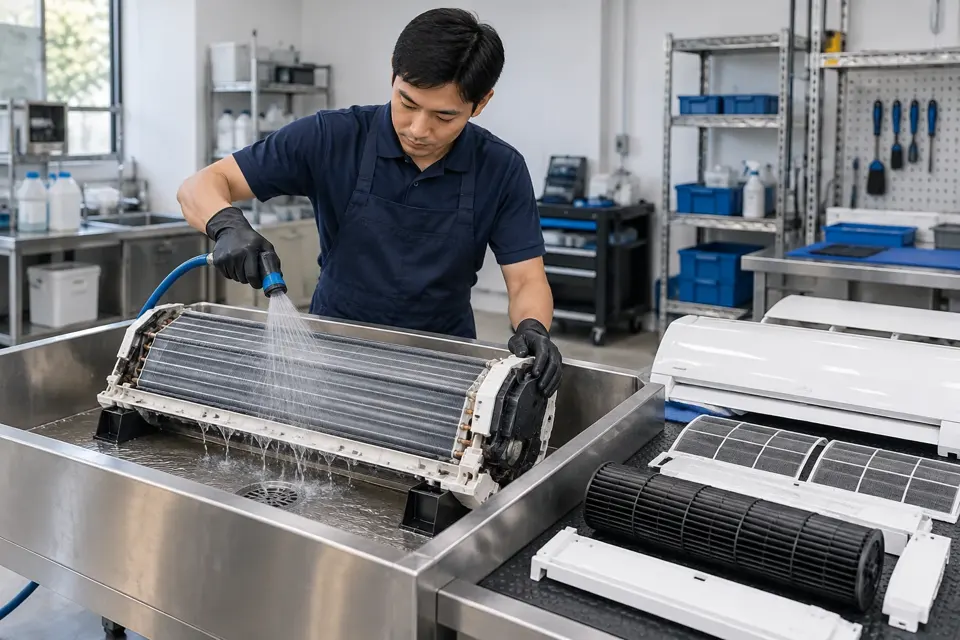
Illustrative example: a split unit looks spotless after washing, yet airflow remains weak. A clean cover does not establish that the blower, drain pan and hidden surfaces received effective attention. Ask what was actually cleaned.
Choose cleaning by access and condition, then verify the unit after reassembly.
Access and disassembly depend on the model and condition.
In-place cleaning has a useful scope
Keeping the unit mounted can be appropriate when its design provides access to the necessary surfaces and allows protection and water collection. It does not automatically mean every side of the blower or every drain-pan recess can be reached.
Request a scope covering filters, heat exchanger, blower, pan and drainage. Ask which areas remain inaccessible. Unnecessary dismantling is not proof of better service, either.
Dirt and cleaning methods both matter
Dust mixed with moisture can form deposits that obstruct airflow or drainage. Uneven buildup on a rotating blower may contribute to vibration and noise. It is not accurate to claim that every muddy deposit inevitably burns out a motor; motor failure needs diagnosis.
Cleaning can introduce its own damage if water reaches controls, connections or a motor, or if unsuitable pressure and tools harm fins and components. Effective cleaning should preserve the equipment as well as remove dirt.
When deeper access may be justified
Heavy deposits in the blower or pan, or surfaces that cannot be cleaned effectively in position, may justify removing selected components. The recommendation should identify the inaccessible contamination and the model-specific work required.
| Finding | Discussion with the technician |
|---|---|
| Accessible light contamination | Appropriate routine cleaning |
| Hidden heavy deposits | Need and limits of dismantling |
| Persistent smell or noise | Diagnosis before another wash |
Dismantling is model-specific work
Access may involve blower fasteners, motor supports, casing sections, the pan or electrical connections. Designs differ. A qualified technician should follow the manufacturer’s service information for isolation, protection, reassembly and checks rather than applying one removal sequence to every unit.
After cleaning, verify drainage, leaks, secure refitting and the absence of new rubbing or vibration. Before-and-after photographs should show comparable surfaces. An odour does not establish a particular biological contaminant, and washing alone should not be sold as a health guarantee.
How NACE handles workshop cleaning
The indoor unit is removed at the customer’s premises and taken to the workshop for disassembly and washing. It is then reassembled, returned, reinstalled and tested on site. The quotation specifies any outdoor-unit cleaning, materials or repairs included in the service.
How should you compare cleaning prices?
Start with the number of systems and the scope for each one. A washing quote may cover only the indoor unit, while another includes the outdoor unit or removal of components. The label “deep cleaning” is not enough to establish that two offers include the same work.
| Before approving | What the quote should state |
|---|---|
| Equipment coverage | Indoor unit, outdoor unit or both, and the number of systems |
| Removal and transport | Components involved, cleaning location and reassembly |
| Acceptance | Drainage and operating checks, with remaining observations recorded |
Keep fault repair and replacement parts separate when they are outside the cleaning scope. If additional work is proposed after opening the unit, request an explanation and price before approval. For an office with several units, agree room access and work order so offers are compared against the same arrangements. Check whether each quoted amount includes tax.
Questions & acceptance checklist
- Define the included components.
- Inspect blower, pan and drain.
- Justify dismantling first.
- Protect electrical parts and finishes.
- Record drainage and operating checks.
Before you decide
Must the indoor unit come off the wall every time?
In NACE’s workshop cleaning service, the indoor unit is removed, taken to the workshop for deep cleaning, then returned, reinstalled and tested. Cleaning methods in general vary with the model, condition and agreed scope.
Does black wash water prove a complete clean?
It shows dirt was removed from washed areas, not that all hidden surfaces were reached.
Will fragrance solve an odour problem?
It may mask it. Investigate the source and use only suitable manufacturer-approved cleaning materials where needed.
Plan your AC service in Jeddah
Share the equipment type, approximate quantity, site and symptoms so the team can assess the inspection or installation scope.
AC maintenance, installation and ductwork in Jeddah
Request a maintenance visitTechnical & editorial references (5)
References support general principles. Product instructions and the approved design govern execution details.
- Mitsubishi Electric — Cleaning filters, heat exchanger and accessible fan
- Mitsubishi Electric — MFZ-KW operating instructions, cleaning precautions
- LG — Dust and black water from the drain hose
- Cambridge Air Solutions — Blower dirt, airflow and possible imbalance (M-Series manual, blower cleaning section)
- Carrier — Coil cleaning and protection of delicate fins