
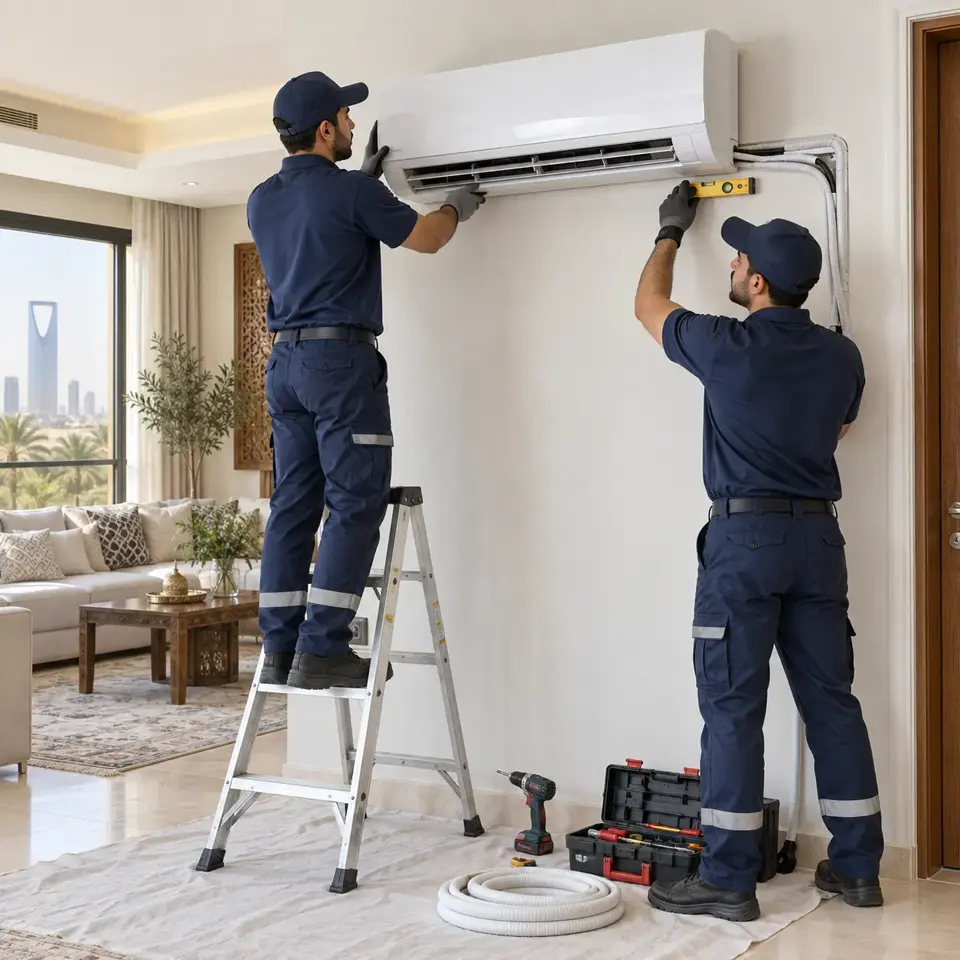
Illustrative example: a new split unit hangs neatly above a finished wall. Water appears after use because drainage was never properly checked. Appearance alone cannot establish installation quality.
Assess installation through specifications, tests and records alongside the visible finish.
Choose locations for operation and future access
Consider air distribution, the model’s clearances, outdoor airflow and access for cleaning or repair. Review pipe length and elevation difference against the selected model, rather than assuming that any empty wall and roof position will work.
Agree the route before drilling. The location should support operation and maintenance without repeatedly disturbing finishes.
Specify materials rather than broad labels
The equipment instructions determine liquid and gas pipe sizes and relevant material, thickness and length requirements. One diameter does not suit every split system, and a country of origin is not a replacement for a specification. Describe insulation, connections, support and outdoor protection.
Electrical conductor size, protection, earthing and supply arrangements also depend on equipment data and installation conditions. Have the qualified specialist define them; “heavy-duty cable” is not a complete specification.
Leak testing and vacuum drying do different jobs
Leak testing checks circuit integrity using the manufacturer’s procedure. Vacuum drying removes air and moisture from the installed section. Neither substitutes for the other, and releasing refrigerant to push out air does not replace the prescribed evacuation process.
Include testing, evacuation and commissioning in the work scope. A universal number of minutes cannot demonstrate successful evacuation for every installation; the relevant procedure and verification are what matter.
Test drainage before concealment and handover
Check the route, connections, insulation where needed, and gravity or pump arrangements appropriate to the design. The technician should demonstrate drainage with the model-appropriate test. A brief initial run without visible dripping is not comprehensive proof.
| Element | Useful handover evidence |
|---|---|
| Piping | Specification and concealed-work photographs |
| Circuit | Leak-test and evacuation records |
| Drain | Flow and leakage check |
| Operation | Commissioning observations |
Define where the installation scope ends
For an enquiry to NACE, distinguish installation on existing provisions from new first-fix work. Define who supplies materials, included lengths, making good, access equipment and additional parts. Obtain agreement before changes to the route or model alter the work.
At handover, request equipment identification, basic control guidance, filter access information and a record of remaining observations.
Equipment supply or installation only?
First establish whether the contractor supplies a specified unit or installs equipment you already own. Then distinguish installation on existing provisions from a new piping route. The quotation should identify the quantity and inclusions for each item so materials are neither counted twice nor left outside an apparently complete price.
| Item | What to define |
|---|---|
| Equipment supply | Model, condition and quantity, separate from installation labour |
| Installation | Included mounting, connections and tests for the paired units |
| Extra materials | Measurement unit, included components and approval of the rate |
When a quotation includes a stated piping allowance, ask how any extra measured length will be agreed. Record the condition of existing provisions and whether checking them is included. These distinctions make the complete installation cost easier to compare, while route approval and model-specific requirements still need to be resolved before work begins.
Questions & acceptance checklist
- Approve unit locations and route.
- Match piping and insulation to the model.
- Confirm electrical requirements.
- Record circuit and drainage tests.
- Retain commissioning information.
Before you decide
Does new equipment still require vacuum drying?
The installer must follow the model instructions when connecting the refrigeration piping. New equipment does not remove those requirements.
Is “copper included” a sufficient description?
Request sizes, specification, length, insulation and connection details, together with the limits of electrical, drainage and making-good work.
Is moving the indoor unit later a minor change?
It can change piping, drainage, electrical work and circuit procedures. Have the implications assessed before relocation.
Plan your AC service in Jeddah
Share the equipment type, approximate quantity, site and symptoms so the team can assess the inspection or installation scope.
AC maintenance, installation and ductwork in Jeddah
Request an AC quotationTechnical & editorial references (2)
References support general principles. Product instructions and the approved design govern execution details.